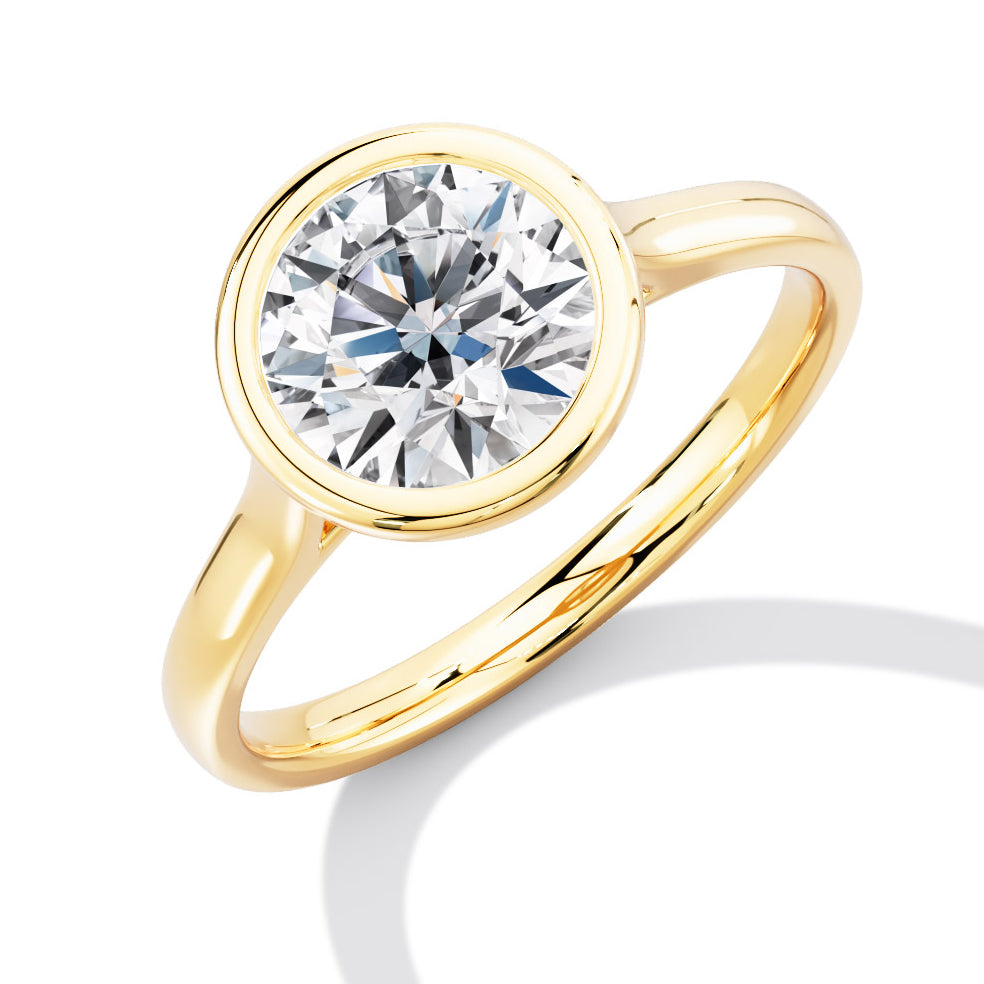


The diamond in an engagement ring is there to mark a promise, and it’s worn every day for years afterwards. Lab-grown diamonds have become an important option alongside natural ones, so one of the first choices now is whether that stone formed in the earth or was grown in a laboratory.
A lab-grown diamond is a real diamond. What differs is where it came from, what it costs and what you can expect if you ever sell it. If you’re still working out the rest of the stone, how to choose a diamond covers the 4Cs, shapes and certificates.
At Anupam, our engagement rings are set with natural or lab-grown diamonds, and the centre stones are certified by IGI or GIA.
Is a lab-grown diamond a real diamond?
Yes. A diamond is carbon arranged in one particular crystal structure, and that is exactly what a lab-grown diamond is. It isn’t an imitation or a lower grade of diamond, and it scores the same 10 on the Mohs hardness scale as a natural one.
Look-alikes are a different matter. Cubic zirconia and moissanite are different materials altogether, with their own hardness, sparkle and price, and neither should be described as diamond. We explain how they compare in moissanite, lab-grown or natural diamond.
How are lab-grown diamonds made?
A lab-grown diamond is grown from a tiny diamond seed, in one of two ways:
- High pressure, high temperature (HPHT): the seed is held under very high pressure and heat, and new diamond grows on it from a carbon source.
- Chemical vapour deposition (CVD): the seed is placed in a chamber of carbon-rich gas, and the crystal is built up on it layer by layer.
Either way, the result is diamond. A natural diamond, by comparison, formed deep in the earth, in most cases over a billion years ago, and was mined.
How do lab-grown and natural diamonds compare?
| Natural diamond | Lab-grown diamond | |
|---|---|---|
| What it is | A diamond formed in the earth and mined | A diamond grown in a laboratory |
| Made of | Carbon | Carbon |
| Hardness | 10 on the Mohs scale | 10 on the Mohs scale |
| Can you tell by eye? | Not reliably from a lab-grown diamond | Not reliably from a natural diamond |
| The report | From an independent laboratory such as GIA or IGI | From an independent laboratory such as IGI or GIA, stating that it is lab-grown |
| Price, same size and grades | Higher | Lower |
| If you sell it | Holds some value, a fraction of what you paid | Little, and the market is still young |
| In our engagement rings | Yes | Yes |
Prices and resale depend on the individual stone and on the market at the time, so treat those two rows as a general picture rather than a promise.
Can you tell the difference by looking?
Not reliably, even under a jeweller’s loupe. The two have the same sparkle and the same range of colours. Establishing which is which takes specialist laboratory equipment, which is why the paperwork matters so much.
A standard diamond tester can’t separate them either. It works by measuring how a stone conducts heat, and both conduct heat in the same way, so both read as diamond. Telling a diamond from a look-alike is a different job, covered in how to tell if a diamond is real.
How do you know which one you’re buying?
From the certificate. GIA and IGI both grade natural and lab-grown diamonds, and the report states which one it is. Lab-grown stones usually carry a tiny laser inscription on the edge that says so too.
A lab-grown diamond should always be sold as lab-grown, and we always say which is which. If you’re offered a diamond without a report, ask how the seller knows where it came from before you go any further.
How much cheaper is a lab-grown diamond?
For the same size, cut, colour and clarity, a lab-grown diamond costs noticeably less than a natural one. Lab-grown prices have also fallen as more stones are produced, and they vary widely between sellers, so compare current prices rather than trusting a figure in an article, this one included.
The saving is all in the stone. The setting and the metal around it are the same either way, so a lab-grown centre stone often means a larger or finer diamond for the same budget. Setting a budget is covered in how much to spend on an engagement ring.
To compare prices fairly, compare like with like: the same shape, carat weight, colour, clarity and cut grade, each on an independent report.
Do lab-grown diamonds hold their value?
Not well, and it’s worth knowing before you buy. Jewellery of any kind sells for much less than it costs new. The price you pay includes the setting, the making and the retailer’s costs, while a buyer pays only for the stone and the metal.
A natural diamond holds some value and has a long-established market, though you should expect to be offered a fraction of what you paid. Lab-grown diamonds have a much younger market, their prices have been falling, and a resale offer is lower still.
Neither stone is an investment. If resale matters to you, tell us before you choose and we’ll go through what to expect.
Are there any downsides to a lab-grown diamond?
Resale is the main one. A stone bought today may also cost less to replace in a few years than you paid for it, which affects the figure on an insurance valuation.
Origin matters to some people in other ways too, such as how a stone was mined or the energy used to grow one. Ask whoever sells it, and expect a straight answer.
Natural or lab-grown: which suits you?
Choose a natural diamond if its origin matters to you: a stone that formed in the earth over a very long time.
Choose a lab-grown diamond if you want more diamond for your budget.
Either way, ask for the certificate, and compare the stones on your hand in daylight as well as under the shop lights.
See both side by side
Browse our engagement rings, our lab-grown collection or our diamonds. If you’re still torn, book a time with us in Ashford and we’ll go through the certificates together, with natural and lab-grown stones side by side.
Frequently asked questions
Will a lab-grown diamond pass a diamond tester?
Yes. It is diamond, so a standard tester reads it as one.
How much is a one-carat lab-grown diamond worth?
There isn’t a single figure that stays right for long. The price depends on the cut, colour and clarity of the individual stone and on the seller.
Is a lab-grown diamond the same as moissanite?
No. Moissanite is a different gemstone, made of silicon carbide rather than carbon, and it sits at about 9.25 on the Mohs scale against diamond’s 10. It often shows stronger rainbow flashes than a diamond, lab-grown or natural.
Can I insure a lab-grown diamond ring?
Yes, in the same way as any other ring. An insurance valuation records that the stone is lab-grown and gives a replacement value at current prices. Our post on engagement ring insurance explains what an insurer will ask for.