

A signet ring was once a person’s signature. Its face was pressed into wax to seal a letter, and the mark it left said who the letter was from. Few people seal letters now, but the idea has lasted: a signet is a ring that belongs to one person, and it often goes on to belong to the next generation of a family.
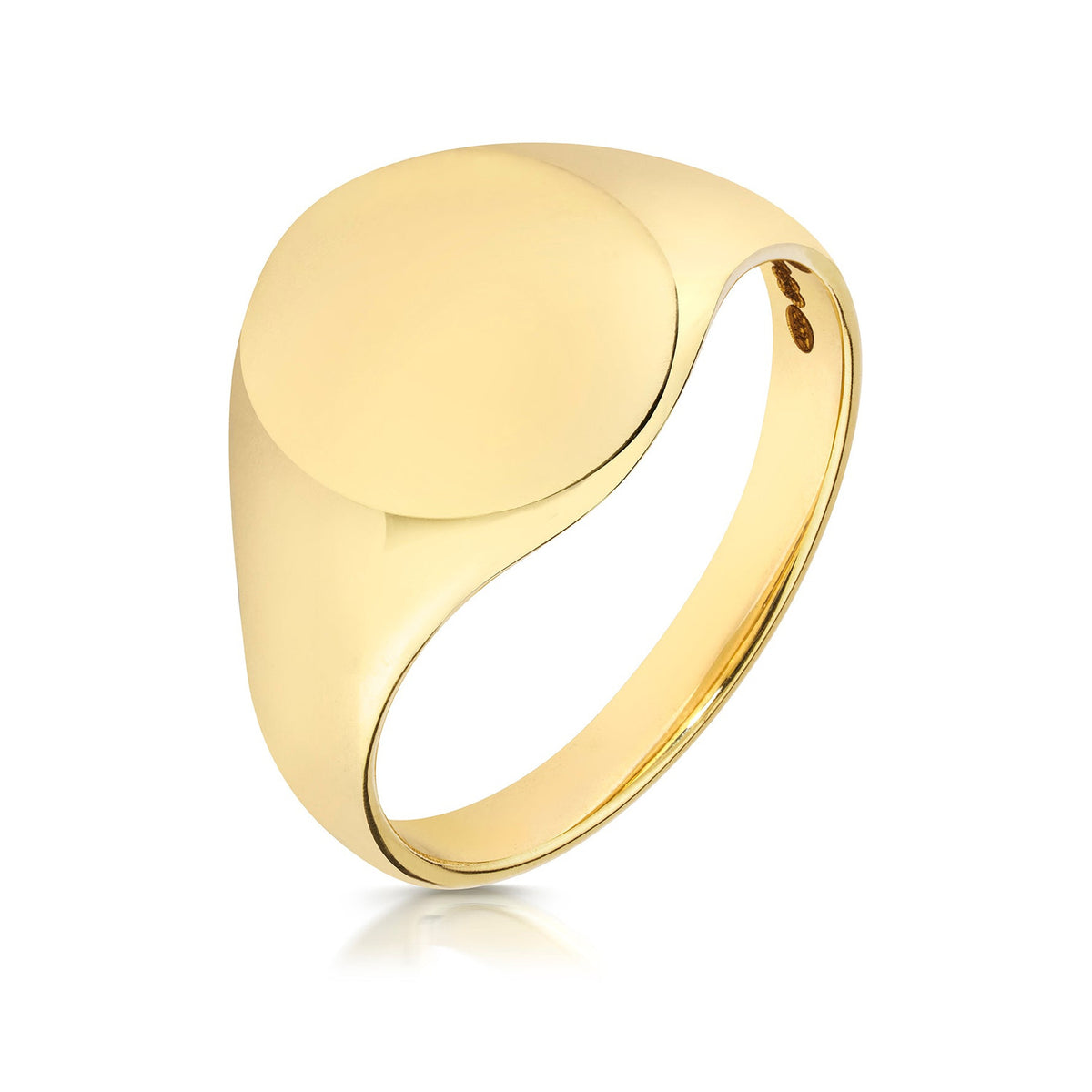
A signet ring is a ring with a flat face, plain or patterned, worn as a mark of identity or family. It’s also a classic coming-of-age gift, which our guide to how to choose a gift that lasts covers.
Where do signet rings come from?
The word comes from the Latin signum, a sign or mark. Signet rings have been used as seals for thousands of years, in ancient Egypt and Rome among other places. The design on the face was cut in reverse, so that when it was pressed into clay or warm wax it printed the right way round, and the impression stood in for a signature.
Over the centuries the signet became a family ring. Coats of arms and crests were engraved on the face, and the ring passed down with the name.
What does a signet ring mean today?
For most people it’s personal rather than official. A signet might mark an 18th or 21st birthday, carry a family crest, or simply be the ring someone has always worn.
Many are handed down. A signet that belonged to a parent or grandparent carries that history with it, and it can usually be resized and restored to wear again. If you’ve been left one, what to do with inherited jewellery covers your options.
Which finger do you wear a signet ring on?
The traditional place in Britain is the little finger of the left hand, often explained as keeping the ring clear of the hand you write with. Plenty of people wear a signet on the ring finger or the index finger instead, or on the right hand.
The finger matters for the size. A little finger usually takes a smaller size than a ring finger, so measure the finger the ring will actually go on. How to find your ring size shows how.
Can anyone wear a signet ring?
Yes. Signets were worn by anyone who needed a seal, so there’s no one a signet is meant for. Choose a face that’s comfortable on your hand: a smaller face sits neatly on a slender finger, and a larger one makes more of a statement.
What styles of signet ring are there?
Signets differ mostly in the face. The traditional shape is oval, and round, cushion and rectangular faces are common too. A face may be plain and polished, or it may already carry an engraved pattern or a crest-style design. We stock plain, patterned and stone-set signets, though not every style in every finger size.
The size of the face is worth trying on. A wide face can feel snug across the finger.
If you’d like initials or a crest engraved on the face, ask us. We offer engraving, depending on the ring: it comes down to its size and whether it sits on our machine without moving or slipping. A hollow signet can’t be engraved, because of the pressure of the diamond cutter.
What should you look for when buying a signet ring?
- The metal. 9ct gold (375) is a practical choice for a ring worn every day, and depending on the alloy it can be harder than 18ct gold. 18ct gold (750) has a richer colour and may show fine scratches sooner. Sterling silver (925) is more affordable, but it’s relatively soft and it tarnishes, so it needs the occasional polish. Online, our signet rings are 9ct gold. In the shop we also have sterling silver signets, and we make 18ct gold and platinum 950 signets to order through our bespoke service.
- Solid or hollow. A solid signet feels heavier and wears longer. A hollow one is lighter, can dent and can’t be engraved. Ask which you’re looking at.
- The hallmark. A solid 9ct gold signet is far above the 1g weight at which gold needs a hallmark; a small sterling silver one can sit close to the 7.78g limit, so it may carry none. Look inside the band. UK hallmarks explained shows how to read the marks.
For more on how each metal wears, see how to choose a metal.
Can a signet ring be resized?
Most can, at our bench in Ashford. A ring with a pattern running all the way round the band needs a jeweller’s judgement first, because resizing means cutting into the band. Ring resizing explains what can and can’t be changed.
An old signet is worth checking before you wear it every day. The underside of a ring can thin over many years of wear, and a family signet may have had decades of it. Bring it in and we’ll look at it with you.
Find a signet ring that suits you
Browse our signet rings, 21 in all, or book a time with us in Ashford to try a few on. Tell us which finger you have in mind and we’ll check your size for it while you’re here.
Frequently asked questions
Is a signet ring a good 18th or 21st birthday present?
It’s the traditional one. If you’re buying it as a surprise and have to guess the size, a near guess can usually be put right.
Which hand do you wear a signet ring on if you’re left-handed?
By the same reasoning as the left little finger tradition, the right hand makes sense. In practice, wear it wherever it’s comfortable.
Can you wear a signet ring with a wedding ring?
Yes. They usually go on different fingers, so they don’t touch. If you wear both on the same finger, they’ll rub where they meet, and different metals can wear against one another, so it’s worth having the pair looked at.
What is the difference between a signet ring and a seal ring?
Historically they were the same thing. A ring used as a seal has its design cut deep enough to leave a clear impression in wax. Many signets worn today are made to be worn rather than used as a seal.
Will the pattern on a signet ring wear away?
Over many years, wear and repeated polishing can soften the edges of an engraved pattern, because each polish removes a small amount of metal. Mention the pattern before any polishing or repair, so the work can be planned around it.