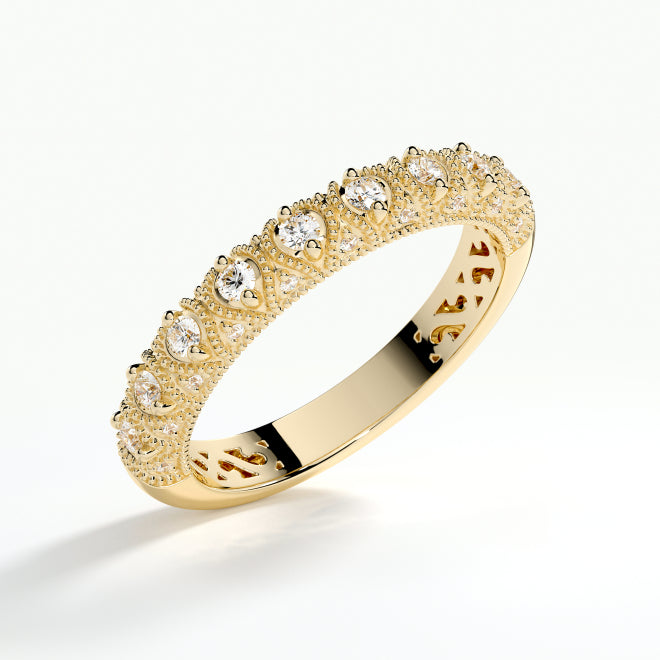


An engagement ring and a wedding band are worn side by side for years, so they need to sit well together. A shaped wedding band has a curve, a notch or a V built into it, so it sits flush against an engagement ring where a straight band would leave a gap.
There are two kinds: ready-made curved bands, which suit many engagement rings, and bands designed from a scan of your own ring, so the fit is exact. Our guide to how to choose a wedding band covers profile, width, weight and metal. Here, we look at what to do when a classic straight band and your engagement ring don’t sit together.
At Anupam, we laser-scan engagement rings and design shaped bands to fit them in 3D CAD, in our own workshop in Ashford.
What is the point of a curved wedding band?
A straight band meets an engagement ring along one flat edge. If the engagement ring has a halo, a low-set stone or claws that stand out from the band, the two can’t sit flush. You get a gap, or an engagement ring pushed out of line. A shaped band follows the outline of the engagement ring instead, so the pair looks like one piece of jewellery.
Fit matters for comfort as well as looks. Two rings that sit closely together are less likely to knock against each other’s stones or twist round on the finger.
Which engagement rings need a shaped band?
These settings most often need a shaped band:
- a halo or hidden halo, where the setting is wider than the band;
- a stone set low, close to the finger;
- a trilogy with large side stones;
- a toi et moi, with two stones side by side (see toi et moi rings);
- a sculpted, curved or twisted band that a straight edge can’t follow.
Look at your engagement ring from the side, not from above. If daylight shows between it and a straight edge, a straight band will leave the same gap.
What are curved wedding rings called?
The same idea goes by several names, and shops use them loosely. Shaped, curved, contoured, wishbone, fitted: they all mean a band that isn’t straight.
| Name | What it is | What it suits |
|---|---|---|
| Curved or contoured | A soft arc running through the band | A halo or a raised head |
| Wishbone | A V cut into the top of the band | A pear, a marquise or any stone with a point |
| Notched or cut-out | A section removed to make room for the stone | A low-set or large stone |
| Fitted, or shaped to fit | Designed from your own ring | Any engagement ring, especially an unusual one |
Should I choose a ready-made curved band or one made to fit?
A ready-made curved band is a general shape. It suits many engagement rings, but not all of them, because every ring has its own outline. If it sits flush when you try it beside your ring, it can be a good, simple answer. We do keep ready-made curved and wishbone bands in the shop. With so many different curves and angles, though, most shaped bands end up being made through our bespoke service.
A band made to fit is designed around your ring alone. That is also its limit: because it’s made for that ring, the band may need to change too if you ever have your engagement ring reset.
| What to consider | Ready-made curved band | Band made to fit |
|---|---|---|
| How it fits | A general curve that suits many rings | Follows the outline of your own ring |
| How it’s chosen | You try it on beside your engagement ring | Designed from a laser scan of your ring |
| How long it takes | Sooner | Longer, because it’s scanned, designed and made |
How does a shaped-to-fit band work at Anupam?
- Bring your engagement ring in. Book a time with us and bring the ring along.
- We laser-scan it. The scan records the shape of your ring in three dimensions: the curve of the band, the height of the setting and where the stones sit.
- We design the band in 3D CAD. Working from the scan, the band is drawn to follow the curves of your ring and sit close against its stones, so there’s no gap.
- The band is made to match. Matching the metal of your engagement ring is usually sensible, because rings that touch wear against each other, but it isn’t a universal rule. Like any band above the legal exemption weights, it will carry a hallmark; here’s how we approach hallmarking.
How much does a shaped wedding band cost?
There’s no typical price. A band shaped to fit falls under our bespoke service, and the price depends on a lot of factors: the metal, any gemstones and how complex the design is. The best way to start is to book a consultation, so we can go through it with you in detail.
You can read more about the service on our workshop page.
When should I order my wedding band?
Earlier than you might think. A band made to fit needs your engagement ring scanned first, then designed and made, so it takes longer than a ready-made band: between four and six weeks, including the time for hallmarking.
Our advice: if the wedding has a date, bring your engagement ring in early and tell us the date when you do.
Do I need a shaped band at all?
Not always. If your engagement ring is a simple solitaire, a classic band will often sit well beside it. Our wedding ring builder lets you choose from six profiles, widths from 2mm to 8mm and four weights, in 9ct, 14ct or 18ct gold, platinum 950, or palladium 500 or 950.
For how to wear the two rings together, see which finger, and in what order.
Find a band that sits with your engagement ring
The surest way to know is to see the two rings together. Book a time with us in Ashford and bring your engagement ring. We’ll look at it with you beside a straight band and, if there’s a gap, talk you through the options.
Frequently asked questions
Can a shaped band be worn on its own?
Yes, though the curve or V will show. Some people like the look. If you expect to wear your wedding band without your engagement ring, look at the shaped band on its own before you decide.
Can I have a band made to fit an engagement ring I’ve had for years?
Yes. The scan records your ring as it is now, so it doesn’t matter how long you’ve had it. If the claws or setting have worn, have them checked before the scan, so the band is designed around a ring in good order.
Will my rings still rub against each other?
Rings that touch will always wear a little where they meet. Have both checked from time to time, particularly the claws of the engagement ring.
Do I need to leave my engagement ring with you?
Normally only for the laser scan. Once it’s scanned, we’ll contact you to collect it, so you can keep wearing it while the wedding band is being made.