
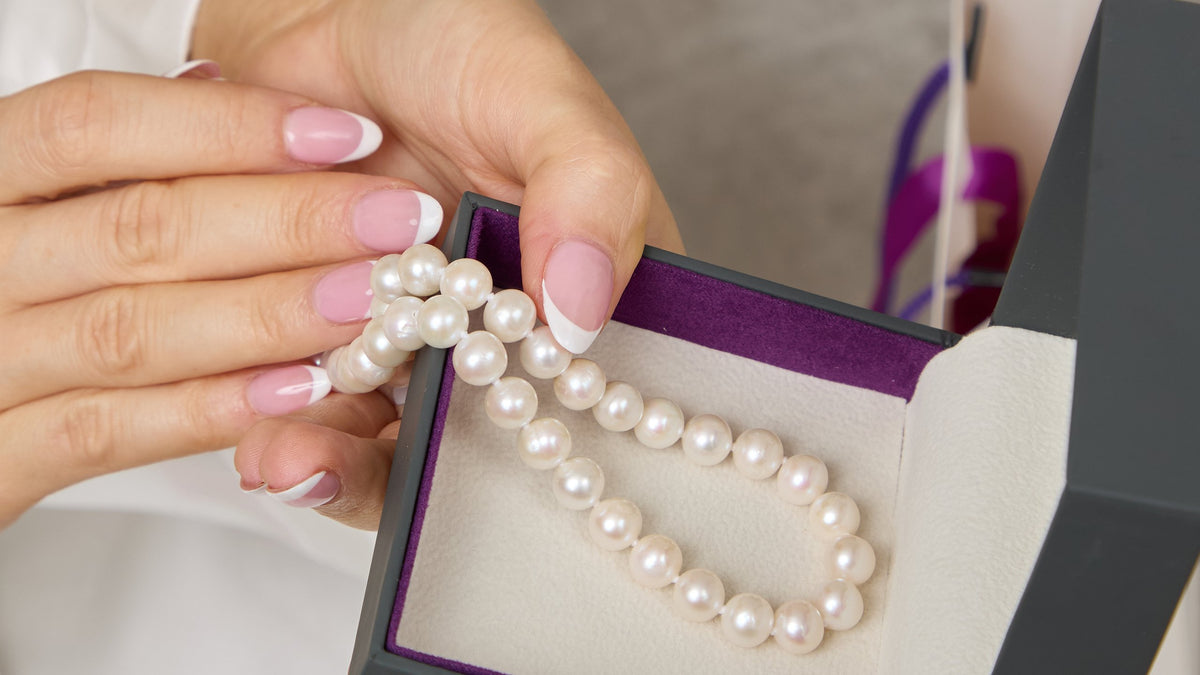

Pearls are often the jewellery that gets passed down. A strand might have been worn on a wedding day, given for a special birthday or kept in a drawer since someone you love last wore it. When pieces like these come to you, it is natural to wonder what they are.
The quickest test is to rub a pearl gently against the edge of a front tooth. It is a useful first clue rather than proof, so check the lustre, the weight and the drill holes too. Our guide to how to look after your jewellery covers caring for pearls once you know.
At Anupam, we restring pearls on site in our Ashford workshop, with a knot between each pearl. Below, we look at what you can check at home, what a jeweller looks for, and how to tell when a strand needs restringing.
What’s the difference between natural, cultured and imitation pearls?
In practice, real usually means cultured: grown in an oyster or mussel with a little help from people. A cultured pearl is still a real pearl. Natural pearls, formed with no help at all, are rare. Imitation pearls aren’t pearls at all, but usually glass or plastic beads with a coating.
| Natural pearl | Cultured pearl | Imitation | |
|---|---|---|---|
| How it forms | In an oyster or mussel, with no help | In an oyster or mussel, with a little help from people | Made, usually from a glass or plastic bead with a coating |
| Is it a real pearl? | Yes | Yes | No |
| Surface | Thin layers of nacre | Thin layers of nacre | A coating, which can wear or chip |
| How it is told apart | From a cultured pearl, only with X-ray equipment in a laboratory | From a natural pearl, only with X-ray equipment in a laboratory | Often under a loupe, where the coating shows |
Telling a real pearl from an imitation is something you can make a start on at home, and the sections below take you through it.
Does the tooth test work?
Up to a point. A real pearl is built up in thin layers of nacre, which feel faintly rough against a tooth. Glass and plastic beads feel smooth.
The test has limits, though:
- some imitations have a coating that feels a little rough, so a gritty feel doesn’t settle it;
- it can’t tell a natural pearl from a cultured one;
- rubbing can mark a delicate surface.
Our advice: be gentle, and try just one pearl.
What else can you check at home?
Look at the strand in daylight, then work through these checks.
| Check | A real pearl | An imitation, often |
|---|---|---|
| Lustre | A soft glow that seems to come from within, with depth to the reflection | Flat, or a hard glassy shine that sits on the surface |
| Surface | Tiny blemishes, and small differences in shape and size | Every bead identical and perfectly smooth |
| Weight | Feels solid, and heavier than plastic | Plastic feels light; glass feels heavy too, so weight alone settles little |
| Drill hole | Small and neat, with clean edges | Paint or coating chipping around the hole, with another material showing |
No single check is proof. If the results are mixed, or the pearls matter to you, have a jeweller look at them.
Do real pearls have imperfections?
Nearly always, although well-matched cultured pearls can be very even.
Are real pearls cold to the touch?
A real pearl feels cool at first and warms slowly against your skin, while plastic feels warm almost straight away. Glass imitations can feel cool too, so temperature is a clue rather than proof.
Should I try the vinegar test?
No. Pearls are mostly calcium carbonate, which acid attacks, so a test meant to prove your pearls are real can damage them. Perfume and household cleaners are hard on pearls too.
What does a jeweller check?
Under a loupe, the surface of a real pearl shows the fine, layered texture of nacre. A coated imitation looks smooth and even, or finely grainy, and the coating shows where it has worn. A jeweller also checks every drill hole, compares the pearls along the strand, and looks at the thread, the knots and the clasp.
Does a hallmark on the clasp mean the pearls are real?
No. A hallmark tells you what the clasp is made of, not what the pearls are: 375 for 9ct gold, 750 for 18ct gold and 925 for sterling silver. A light clasp may carry no mark at all, because gold under 1g and silver under 7.78g fall below the weights at which a hallmark is required. UK hallmarks explained shows how to read the marks.
Can a jeweller tell a natural pearl from a cultured one?
Not by eye. It takes X-ray equipment in a laboratory.
If the pearls are old, or came to you from a relative, and you want to know what they would cost to replace, an insurance valuation is the place to start. At Anupam, we arrange independent insurance valuations with Shirley Mitchell FGA DGA FJVA, and you can ask whether a laboratory report is worth having for your strand. Jewellery valuations explained covers what a valuation involves and what it costs.
When does a string need restringing?
Pearls hang on thread, and thread wears. Perfume, skin and ordinary wear all fray it over time. Bring a strand in when:
- the thread looks grubby, stretched or discoloured;
- gaps open between the pearls, or the strand looks longer than it used to;
- a knot has loosened, or a pearl slides along the thread;
- the thread is fraying beside the clasp or at a drill hole.
How often depends on how often you wear them, so there’s no fixed interval. Check the thread for wear and tear, and look out for the signs above.
Don’t wait for the thread to break. A strand without knots that snaps can scatter every pearl across the floor, so if you notice any of the signs above, bring it in before you wear it again.
How are pearls restrung?
Each pearl is strung with a knot between it and the next, so the pearls don’t rub against each other, and if the thread ever breaks you lose one pearl rather than the whole strand.
While the strand is on the bench, we can also change its length or fit a replacement catch.
The price of restringing depends on the size of the drill holes, the length of the strand and whether it’s knotted, so bring the pearls in and we’ll take a look and advise. It also gives us a chance to check the catch. Restringing takes about two weeks.
Pearls go on last, after perfume and hairspray, and come off first. Wipe them with a soft, slightly damp cloth, and store them flat rather than hanging.
Bring your pearls to us in Ashford
If you’re not sure whether a strand needs restringing, bring it into our workshop. We’ll look at the thread, the knots and the clasp, and tell you plainly whether it needs doing.
You are welcome to book a time with us, or browse our pearl jewellery.
Frequently asked questions
Can I swim or shower in pearls?
Take them off first. Pool chemicals, soap and soaking are all hard on pearls and on the thread they hang on. If a strand does get wet, lay it flat to dry before you put it away.
Can I wear pearls every day?
You can, but they need a little more care than 9ct, 14ct or 18ct gold or diamonds. Expect the thread to need restringing sooner than on a strand kept for special occasions.
Can pearls go in a jewellery cleaner?
No. Soaking, chemical cleaners and ultrasonic cleaners can all damage pearls and weaken the thread. How to clean gold and diamond jewellery covers the pieces that can be soaked.
Can a broken strand be restrung?
Yes. Gather every pearl you can find, along with the clasp, and bring them in together. If some pearls are missing, the restrung strand may be a little shorter than before.
How much are real pearls worth?
It depends on whether they are natural or cultured, on their size, lustre and surface, on how well they match, and on the clasp. An insurance valuation puts a figure on a strand: the cost of replacing it with a comparable one. If the pearls have come to you from the family, what to do with inherited jewellery may help.