

Jewellery is made to be worn, and the pieces you love most are usually the ones that work hardest. An engagement ring goes through every hand wash. A chain is fastened and unfastened every morning. A strand of pearls inherited from someone you love may only come out for special occasions, but its thread still wears a little each time.
Looking after jewellery comes down to a few habits. Put it on last and take it off first, keep each piece apart from the others, clean it gently at home, and have it checked by a jeweller, particularly a ring that holds a diamond or gemstone.
Most of what goes wrong is easy to put right if it is spotted early. At Anupam, claw work and re-tipping, re-rhodium plating, pearl restringing, chain repairs, polishing and ring sizing are all done on site in our Ashford workshop.
Here, we look at the everyday habits that keep jewellery at its best, and the signs that a piece needs to come in.
What should I do with my jewellery every day?
The simplest habit is “last on, first off”. Put your jewellery on after moisturiser, perfume, hairspray and make-up, and take it off before you wash up or get changed. These products leave a film that dulls stones, and some of them harm softer ones such as pearls and opals.
It also helps to know what to take it off for:
- Swimming and hot tubs. Chlorine and other pool chemicals can discolour 9ct, 14ct and 18ct gold and weaken solder joints over time. Pearls and softer stones cope with them even less well.
- Cleaning and washing up. Bleach and household cleaners are the quickest way to harm a piece.
- The gym, gardening and DIY. Hard knocks bend claws, and gripping a barbell or a spade handle can squeeze a band out of round.
Plain bands are hardier than stone-set rings, and many people never take their wedding ring off. If that is you, rinse off soap and sun cream when you can, and dry the ring afterwards.
How should I store my jewellery?
Keep every piece apart from the others.
| Piece | How to store it | Why |
|---|---|---|
| Rings, earrings and pendants | A lined box with compartments, or a soft pouch for each piece | A diamond will scratch the metal and stones it rubs against |
| Chains and bracelets | Fasten the clasp first, then lay each one away separately | It stops them knotting and kinking |
| Pearls | A soft cloth pouch, laid flat | Hanging them stretches the thread |
| Sterling silver | A pouch, or a sealed bag with an anti-tarnish strip | Sulphur in the air tarnishes it, and damp speeds that up |
Avoid the bathroom, where steam and damp are hard on sterling silver and on thread.
Keep your certificates, receipts and any earlier valuations together, with a photograph of each piece. You’ll want them for a valuation or an insurance claim, and we explain how jewellery valuations work separately.
How do I clean my jewellery at home?
Most everyday pieces need nothing more than warm water and a gentle touch. What suits one piece can harm another, though, so check what yours is made of first.
| Metal or stone | How to clean it |
|---|---|
| 9ct, 14ct and 18ct gold, platinum 950 and diamonds | Warm water, a few drops of mild washing-up liquid and a soft brush |
| Sterling silver | A soft polishing cloth to lift tarnish |
| Pearls, opals, emeralds and other soft or porous stones | Wipe with a damp soft cloth, and never soak them |
To clean 9ct, 14ct or 18ct gold, platinum 950 or diamonds, let the piece sit in the soapy water for a few minutes, brush gently behind the stones, rinse in clean warm water and pat it dry with a soft, lint-free cloth. Work over a bowl, never an open plughole.
Our advice: clean a piece only if its stones are firm. If one moves, leave it alone and bring it in as it is.
The full method, and what not to use, is in how to clean gold and diamond jewellery at home.
How do I know if a claw is loose?
Claws are the small metal fingers that hold a stone in place. Everyday knocks wear them down, and a worn claw is how stones get lost, so on a ring it is the check that matters most.
Look at your ring in good light every few weeks and watch for:
- a stone that moves, tilts or sits lower than it did;
- a gap between a claw and the stone, or a claw tip that has lifted;
- claws worn thin, flat or pointed at the tip;
- a ring that snags on knitwear, tights or hair.
Hold the ring beside your ear, over a soft cloth or a table and never a sink, and give it a very gentle shake. A stone that is held properly is silent. If you hear a tick or a rattle, stop wearing it and bring it in.
A loose claw only gets looser. Tightening or re-tipping one is a far smaller job than replacing a lost stone, and both are done at our bench.
There is no single interval that suits every ring, but a ring you wear every day is worth a check about once a year, even if it looks fine.
Does white gold need re-plating?
From time to time, yes. White gold in 9ct, 14ct and 18ct is usually plated with rhodium, a hard, bright white metal, over the gold beneath. The plating is very thin, so it wears, first where the piece rubs against things, and the warmer colour of the gold underneath begins to show.
That isn’t a fault, and it doesn’t harm the piece. Re-rhodium plating brings the white back, and we do it in our Ashford workshop. How soon a piece needs it depends on its design and how it is worn: a ring that takes knocks every day needs it sooner than a pendant. We charge £50 per ring, and it takes up to a week.
Other metals wear differently:
| Metal | Is it plated? | How it wears | What brings it back |
|---|---|---|---|
| 9ct, 14ct and 18ct white gold | Usually, with rhodium | The plating wears and the warmer gold shows through | Re-rhodium plating |
| 9ct, 14ct and 18ct yellow and rose gold | No, the colour runs through the alloy | Fine scratches | Polishing |
| Platinum 950 | No, it is naturally white | Fine scratches and a soft, lived-in patina | Polishing, if you prefer it bright |
Repeated polishing removes a small amount of metal each time. You can read more about plating in why white gold turns yellow.
When do pearls need restringing?
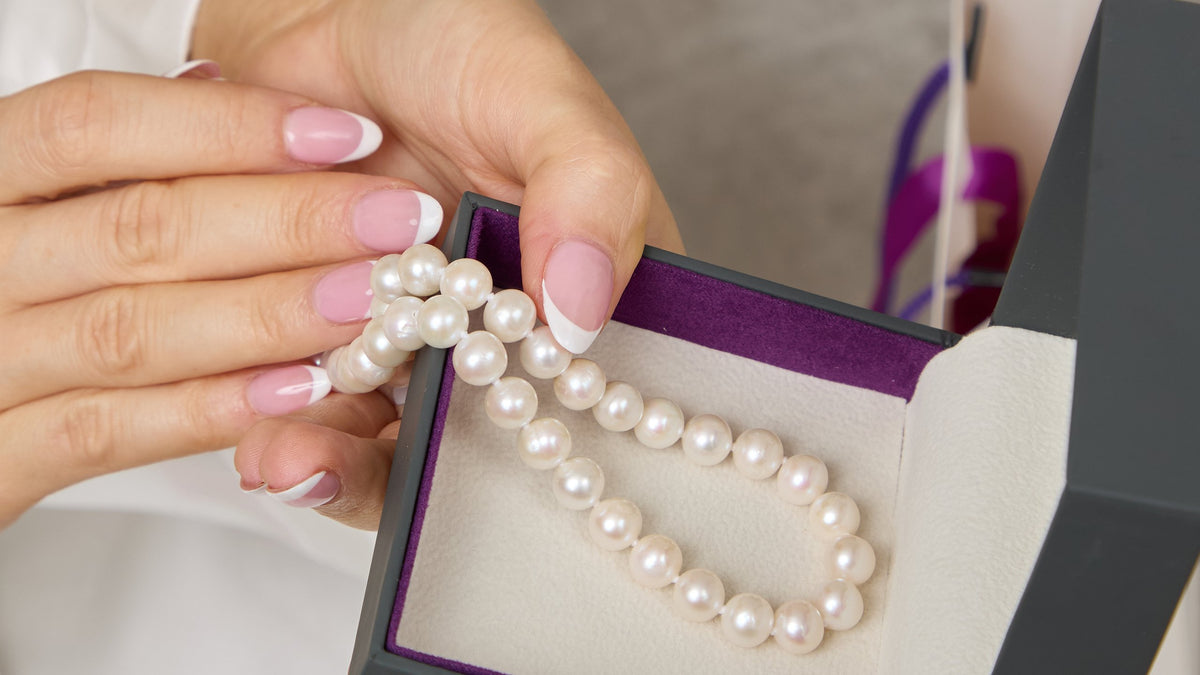
Pearls hang on a thread, traditionally silk, and that thread stretches and frays with wear, perfume and the pearls’ own drill holes. It is best to restring a strand before it breaks. The signs are:
- a dirty or darkened thread;
- small gaps between the pearls;
- a strand that has grown longer;
- fraying where the knots sit.
We restring pearls in the workshop with a knot between each pearl, and we can change the length or fit a new catch while the strand is on the bench. The price depends on the size of the drill holes, the length of the strand and whether it’s knotted, so bring the pearls in and we’ll take a look and advise. It also gives us a chance to check the catch. Restringing takes about two weeks.
To see what a jeweller looks at when checking pearls, read how to tell if pearls are real, or browse our pearl jewellery.
What else means it’s time to bring a piece in?
- A catch that won’t hold, or a clasp that opens by itself. We replace catches.
- A chain with a kinked, stretched or thinning link. Chain repairs are easiest while the damage is small.
- A ring that has worn thin underneath, lost its round shape, or become loose or tight. We size rings here too, and ring resizing explains how it is done.
- A missing stone. Bring the ring in, and the stone too if you have it. We replace diamonds and gemstones, and can match a replacement for colour.
- A dull, scratched finish. Polishing brings the shine back.
- A watch that has stopped. We fit watch batteries and straps here as well, although we no longer service certain watch brands.
Have your jewellery checked in Ashford
If you’re unsure whether something needs attention, bring it in. We would far rather look at a piece that turns out to be fine than see a stone go missing. We do check and clean jewellery while you wait, depending on how busy we are, so it’s always best to book your pieces in.
The easiest way to start is to book a time with us in Ashford. You can see everything our bench does in the workshop guide and on our workshop page.
Frequently asked questions
Can I wear my jewellery in the shower?
A plain band in 9ct, 14ct or 18ct gold or platinum 950 is unlikely to come to harm, but take off pearls, opals and other porous stones first.
Does platinum 950 need less looking after than white gold?
Platinum 950 is naturally white, so it never needs the rhodium plating that white gold does from time to time. It still marks with wear, and the underside of a ring can thin over many years, so settings and claws need checking whichever metal you choose. Which metal is best for a ring you wear every day? compares the options.
Why has my sterling silver gone dark?
Sterling silver tarnishes when sulphur in the air reacts with its surface. The tarnish sits on the surface, so a soft silver polishing cloth will usually lift it. If it is packed into detail you can’t reach, bring the piece in.
Do lab-grown diamonds need different care?
No. A lab-grown diamond is a diamond, with the same hardness as a natural one, so it is cleaned, stored and checked in exactly the same way.
Can I wear my engagement ring and wedding ring together every day?
Yes, but rings worn side by side can wear against each other where they touch, particularly if they are in different metals. How much depends on their shape and how they sit together, so ask us to look at the pair when your ring is in for a check. How to choose a wedding band covers finding a band that sits well with your engagement ring.
How often should my jewellery be revalued for insurance?
There is no single interval that suits every policy. Replacement costs change over time, so if a piece hasn’t been valued for some years, check with your insurer whether an updated valuation is needed. Engagement ring insurance explains what insurers usually ask for.