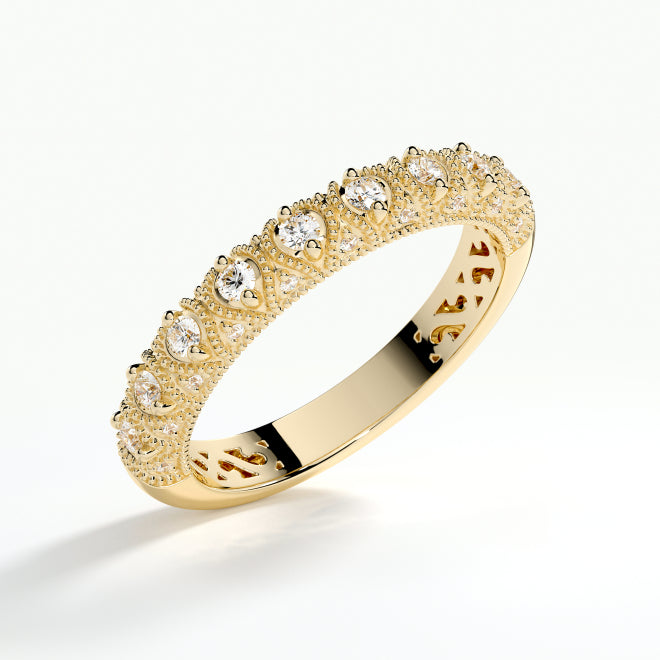


It’s one of the questions we’re asked most, usually a week or two before a wedding: which way round do the rings go? There’s no rule you can break, but there is a tradition, and a few practical reasons behind it.
Which finger?
In the UK, engagement and wedding rings are worn on the fourth finger of the left hand. The old belief was that a vein ran from that finger straight to the heart. It isn’t true, but the custom stuck. In some countries, including Germany, Poland and Russia, wedding rings go on the right hand instead.
The usual order
- Wedding ring first, closest to the hand: by tradition, closest to the heart.
- Engagement ring next, nearer your fingertip.
- Eternity ring last, on the outside, or on the right hand if three rings feel like too many.
On the day itself, many people move their engagement ring to the right hand so the wedding ring can go straight on, then swap it back afterwards.
When your rings don’t sit flush
If your engagement ring has a low stone, a halo or a curved setting, a straight wedding band can leave a gap between the two. A shaped band solves it. We explain how in How to choose a wedding band.
Sizing more than one ring
Two or three rings worn together feel tighter than one, especially wide ones, so a stack sometimes needs half a size more. Full eternity rings, with stones all the way round, generally can’t be resized, so it’s worth getting the size right first. Our ring size guide shows how.
The easiest way to decide is to try the combinations on. Bring your rings in and we’ll help you find the order that feels right.